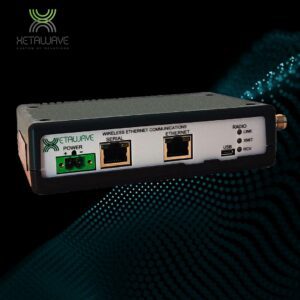

Description
New to Xetawave? or migrating from another brand?
Visit our Xetawave brand page for the full FAQ, network type guide, and migration information for FreeWave, Microhard and MDS networks.
The XetaWave XETA9-11IMDFC industrial wireless Ethernet radio is a metal-enclosed, software-defined radio built for SCADA, telemetry, remote monitoring and industrial automation networks operating in the unlicensed 900 MHz band. It provides licence-free wireless connectivity between control rooms and remote field assets, without the cost, delay and ongoing administration of a licensed spectrum assignment.
Software-defined radio, not fixed firmware
Unlike conventional fixed-function radio modems, the XETA9 is a genuine software-defined radio supporting both Frequency Hopping Spread Spectrum (FHSS) and Digital Transmission System (DTS) operation. Modulation can be selected across MSK, FSK, PSK and QAM schemes to suit available channel bandwidth and the local RF noise environment, rather than forcing a single fixed trade-off between range and throughput.
XetaWave’s patented Dual Decode Digital Architecture improves receiver performance in congested and noisy industrial spectrum — a meaningful advantage on sites where the 900 MHz band is already crowded with existing telemetry, RFID and wireless equipment.
Throughput that scales with the link
Over-the-air data rates range from 10 kbps to 5.3 Mbps, with further gains available through payload compression and Enhanced Multipoint mode. Adjustable RF output up to 1 Watt (+30 dBm) allows power to be matched to link budget and local regulatory limits.
This range matters in practice: narrow channels and low data rates for maximum reach on marginal long-haul links, wide channels and high-order modulation where throughput is the priority.
Advanced network modes
- MultiSpeed — endpoints running at different RF data rates communicate with a single access point, so a slow, distant site doesn’t drag the whole network down to its speed
- XetaEMP (Enhanced Multipoint) — increased throughput and reduced latency compared with traditional multipoint modes
- MESH — frequency-hopping peer-to-peer communications
- Point-to-point, point-to-multipoint and peer-to-peer topologies
Migration path from legacy 900 MHz networks
This is where the XETA9 earns its place on a brownfield site. The radio is over-the-air compatible with MDS 9710/9790, SD9 and TransNET master and repeater radios, and all XetaWave uTasker, Linux, Debian and XetaEdge family radios interoperate.
Practically, that means an ageing 900 MHz telemetry network can be modernised site by site rather than through a single high-risk cutover. New XETA9 endpoints operate alongside existing legacy infrastructure, letting you stage capital expenditure, prove performance incrementally, and retire old hardware on your own timeline instead of the vendor’s.
For operators facing end-of-support notices on legacy radio fleets, this staged approach is usually the difference between a manageable upgrade programme and a full network replacement.
Debian Linux platform
Running open-source Debian Linux on a 300 MHz ARM Cortex-A8 processor, the radio is an open platform rather than a closed appliance. That supports custom application hosting, protocol integration including Modbus RTU and Modbus TCP, scripting, and long-term adaptability as network requirements change.
Security
Over-the-air payload encryption using 128-bit and 256-bit AES protects data across the wireless link — increasingly a baseline requirement for utility and critical infrastructure operators under Australian security-of-critical-infrastructure obligations.
Diagnostics and management
Monitoring of TX and RX statistics including noise floor, RSSI, supply voltage and internal temperature is available over SNMP and Modbus, allowing radio health to be surfaced directly in your existing SCADA or network management system rather than requiring a separate tool.
Built for the field
The metal enclosure and Class 1 Division 2 certification suit hazardous-area installation, while the −40 °C to +75 °C operating range covers unconditioned cabinets, remote pump stations, well pads and outdoor enclosures across Australian climate extremes.
Typical applications
- Water and wastewater pump station and reservoir telemetry
- Electricity utility metering and distribution automation
- Oil and gas well pad monitoring
- Mining site communications and remote asset monitoring
- Broadacre agriculture, irrigation and soil monitoring
- Factory and process automation
- Legacy 900 MHz network modernisation projects
Key Features
- 900 MHz software-defined radio (FHSS and DTS)
- Over-the-air data rates from 10 kbps to 5.3 Mbps
- Adjustable RF output up to 1 W (+30 dBm)
- Dual Decode Digital Architecture for improved receiver performance
- MultiSpeed, XetaEMP and MESH network modes
- AES 128-bit and 256-bit over-the-air encryption
- 1 × 10/100 Ethernet, 1 × RS-232/422/485 serial, 1 × USB
- Debian Linux open platform, 300 MHz ARM Cortex-A8
- SNMP and Modbus diagnostics
- Over-the-air compatible with MDS 9710/9790, SD9 and TransNET masters
- Metal enclosure, Class 1 Division 2 certified
- −40 °C to +75 °C operating range